An international research team coordinated by the Institute of Systems and Robotics – University of Coimbra (ISR-UC), in collaboration with Lawrence Berkeley National Laboratory (LBL) at the University of California, Berkeley (USA), and the Federal University of Mato Grosso (Brazil), has published a major global study on the economic and environmental benefits of optimizing electric motor-driven systems.
The study, entitled “Energy and non-energy cost-benefit assessment of motor system optimization”, presents a novel methodology and assessment model supported by more than 400 case studies from around the world. The most recent motor and drives control technologies were analysed through a comprehensive approach to evaluating the benefits of industrial motor system optimization, considering not only energy savings but also wider economic and operational benefits.
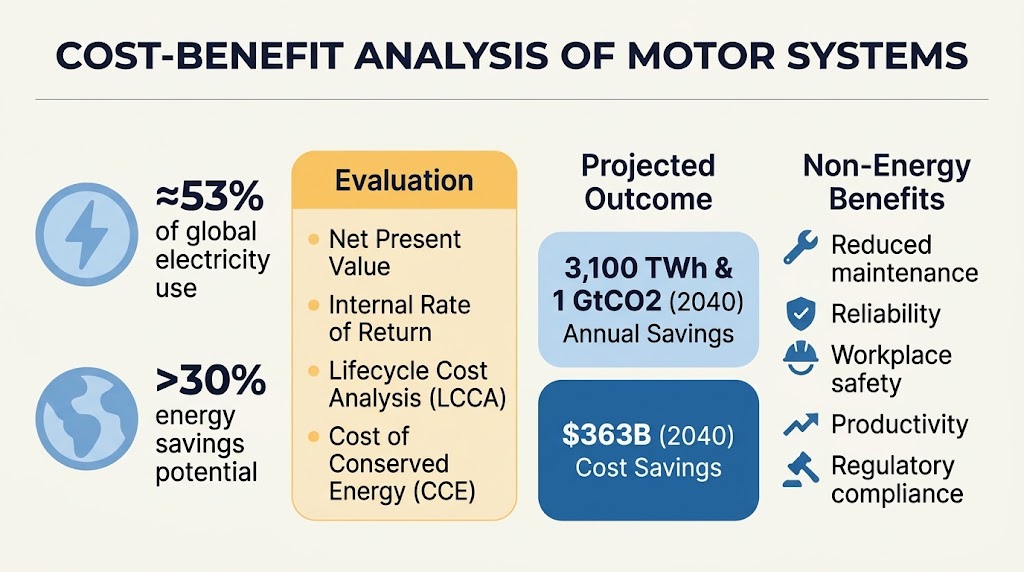
Electric motor-driven systems account for approximately 53% of global electricity consumption, equivalent to around 17.000 TWh annually in 2025. In the industrial sector motors are used to drive all types of production machinery, consuming about 70% of the electricity of that sector. Improving their efficiency therefore represents a significant opportunity to reduce energy demand, operating costs and greenhouse gas emissions across industrial sectors.
The study identifies an ambitious global optimization scenario that could deliver annual energy savings of 3.100 TWh by 2040 (over 50 times Portugal annual electricity consumption), alongside approximately 1.04 billion tonnes of avoided carbon dioxide emissions.
Beyond reducing electricity consumption, the study highlights the potential of motor system optimisation as a strategy that combines energy efficiency, industrial productivity, competitiveness and decarbonisation. The proposed framework can help engineers, facility managers, financial officers and policymakers compare technologies and prioritise investments by considering both energy and non-energy benefits over the lifecycle of industrial systems.
The complete research article is available at https://doi.org/10.1016/j.apenergy.2026.128474
https://www.eceee.org/all-news/columns/non-energy-benefits-play-a-major-role-in-the-cost-benefit-assessment-of-motor-system-optimization-with-a-huge-savings-potential/