
ISR-UC is fully committed to supporting the UN Agenda 2030 Sustainable Development Goals. Our contribution is shown in the strong collaboration with industries and with international development organizations in different parts of the World, as well as in the relevant performance in the various dimensions of sustainable development (social, economic, environmental), which is reflected in our research activities.
The Institute of Systems and Robotics of the University of Coimbra (ISR-UC) is also strongly committed with the development and implementation of an action plan to promote ethics and gender equality, in line with UNESCO's 5th sustainable development goal and the 2020-2025 Gender Equality Strategy of the European Commission.
The ISR-UC Ethics and Gender Equality Working Group (EGEWG) was primarily established with the goals of designing, implementing and monitoring an Ethics and Gender Equality Plan (EGEP), that effectively contribute to attain the EU objectives for gender equality in research:
- Fostering equality in scientific careers;
- Ensuring gender balance in decision-making processes and bodies;
- Integrating the gender dimension in research and innovation contents;
- Defence of employees' ethics.
Select an SDG on the left to view linked projects.
The four-step methodology (see fig. 1) adopted by the EGEWG follows the guidelines and recommendations of the European Institute for Gender Equality, and the Plan for Equality, Equity, and Diversity 2019-2024 of the University of Coimbra.
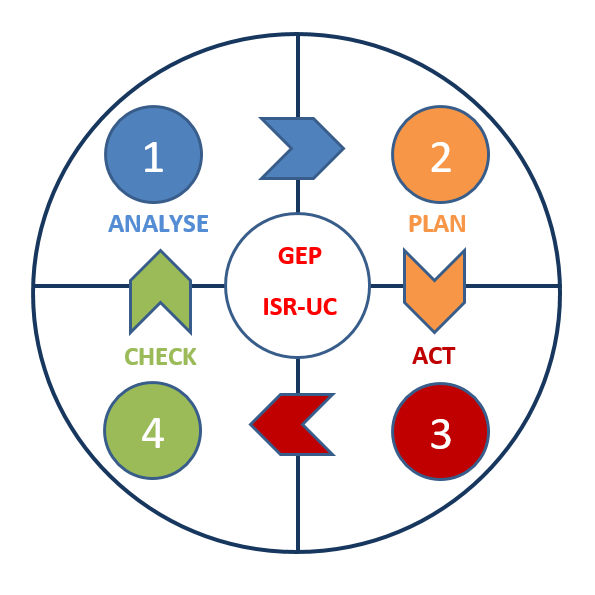
1. ANALYSE
To conduct an extensive diagnosis and analysis regarding gender equality and assessing the state-of-play in ISR-UC.
- Review current legislation, and identify existing measures for gender equality;
- Analyse gender-disaggregated data of staff, researchers and students;
2. PLAN
To establish the strategic objectives, which are essentially defined from the challenges identified in the diagnosis.
To identify the main areas of intervention and design the plan measures accordingly, as well as indicators, timelines, targets and division of responsibilities.
3. ACT
Put the measures of the Gender Equality Plan in motion according to the defined timeline.
For each measure, in addition to identifying the accomplishment indicator(s), the corresponding schedule is established and the units, services and areas to be involved in its implementation are indicated, as well as the responsibility for its accomplishment is also assigned.
4. CHECK
Monitoring the progress and evaluating the GEP.
Monitoring and evaluation instruments are to be foreseen. Such instruments will allow to assess the progress that is made towards targets, based on indicators.
The Institute of Systems and Robotics of the University of Coimbra (ISR-UC) is also strongly committed with the development and implementation of an action plan to promote ethics and gender equality, in line with UNESCO's 5th sustainable development goaland the 2020-2025 Gender Equality Strategy of the European Commission.
The ISR-UC Ethics and Gender Equality Working Group (EGEWG) was primarily established with the goals of designing, implementing and monitoring an Ethics and Gender Equality Plan (EGEP), that effectively contribute to attain the EU objectives for gender equality in research:
- Fostering equality in scientific careers;
- Ensuring gender balance in decision-making processes and bodies;
- Integrating the gender dimension in research and innovation contents;
- Defence of employees' ethics.



Report any situation that violates ISR's code of conduct and ethics.