
Projects
EU STREP
Perception on Purpose
02/01/2006 - 31/12/2008
Research Area
Perceptual and Cognitive Systems
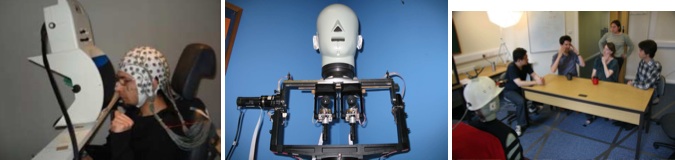
The ease with which we make sense of our environment belies the complex processing required to convert sensory signals into meaningful cognitive descriptions. Computational approaches have so far made little impact on this fundamental problem. Visual and auditory processes have typically been studied independently, yet it is clear that the two senses provide complementary information which can help a system to respond robustly in challenging conditions. In addition, most algorithmic approaches adopt the perspective of a static observer or listener, ignoring all the benefits of interaction with the environment. This project proposed the development of a fundamentally new approach, perception on purpose. which is based on 5 principles :
- visual and auditory information should be integrated in both space and time.
-Active exploration of the environment is required to improve the audiovisual signal-to-noise ratio.
-The enormous potential sensory requirements of the entire input array should be rendered manageable by multimodal models of attentional processes.
-Bottom-up perception should be stabilized by top-down cognitive function and lead to purposeful action.
-All parts of the system should be underpinned by rigorous mathematical theory, from physical models of low-level binocular and binaural sensory processing to trainable probabilistic models of audiovisual scenes.
Reference
FP6-IST-2004-027268
Funding entity
European Union
Role of ISR
Participation