
Organization of the R&D Unit
Overview of the team structure, roles, and workflows that support innovation, collaboration, and the efficient development of new ideas and solutions.
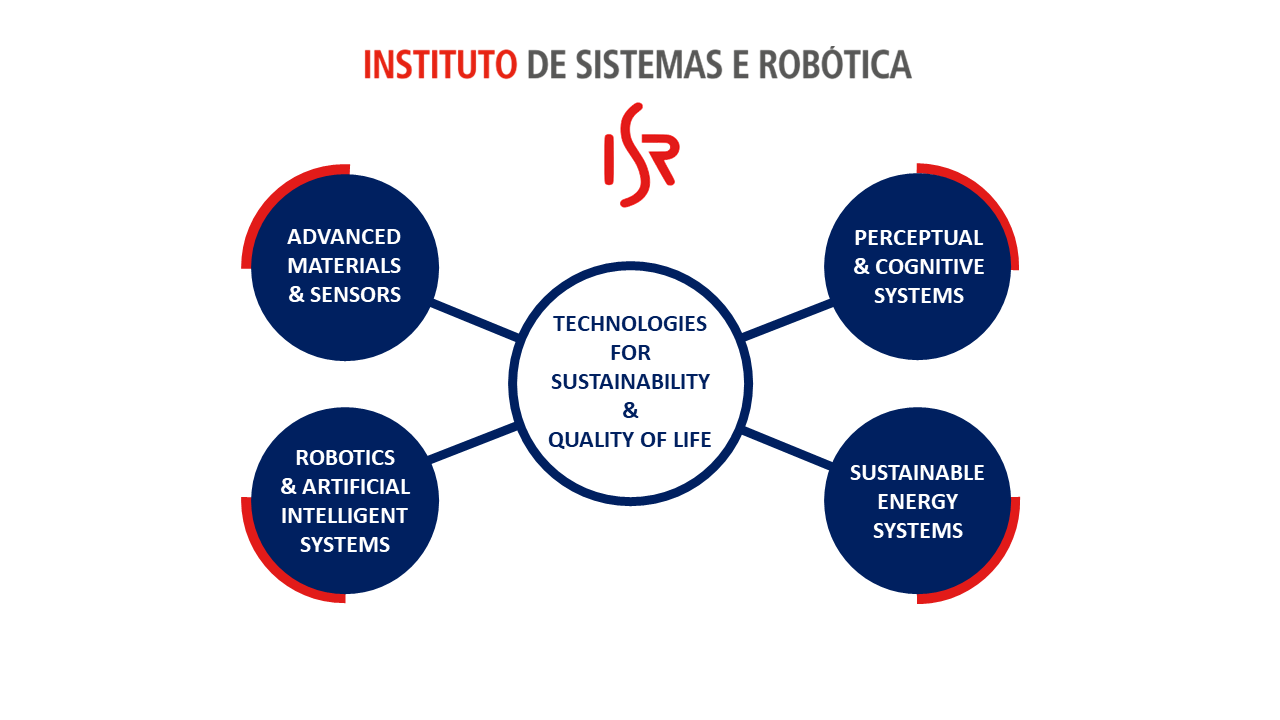
How Research Work Is Organized
The research work is organized in project activities led by senior researchers, bringing together multidisciplinary competences within ISR. Each project activity is usually financed by research projects funded by national and international bodies, such as FCT, P2030, Horizon Europe, or by industry.
Each project activity includes intermediate-level researchers with PhDs (post-docs), responsible for specific topics. MSc and PhD students are typically supervised by the senior activity leader, with support from post-docs.
Internal Collaboration and Synergies
In projects related to different topics across the research areas, there is strong interaction within ISR-UC to leverage synergies, accelerate research, and foster discussion of novel ideas.
Post-docs and PhD students are encouraged to take an active role in proposal writing and in networking and research events such as summer schools and focus groups. Internally, they are also engaged in the annual Open Day @ ISR, including presentations, discussion, and a social event.
Training, Education, and Talent
Training and education are central to enabling cross-fertilization and innovation across disciplinary boundaries. ISR plays an active role in several doctoral programs and provides experimental and scientific guidance to a large number of students (over one hundred).
ISR has successfully attracted high-quality young researchers from eight countries around the world, integrating them into R&D projects and doctoral programs.
Partnerships, Transfer, and Scientific Impact
The activities in the unit are highly interdisciplinary, with strong interaction between activity areas. ISR collaborates with the Faculty of Medicine, health institutions, and research centers (CNC, Rehabilitation Hospital RP, IBILI, and the Life Sciences Institute), as well as with high-technology industries and international centers of excellence.
Cooperation with industry is carried out through research contracts. Patent registration for innovative results with market potential has been continuously pursued, with significant international results over the last five years.
ISR has also promoted technology transfer and the creation of spin-offs associated with research results. The research output is disseminated in top international journals and conferences (over 350 papers in 2018-2023), and ISR has actively contributed to organizing high-ranking international scientific meetings.
International Networks and Actions
ISR maintains strong interaction with leading research centers worldwide through participation in large international projects. It will continue participating in robotics networks of excellence and organizing scientific meetings at the highest level (e.g. IROS, ICRA, IEEE ITSC, ROMAN).
The interaction between the four activity areas is promoted through actions such as:
- Financing research projects through seed funding resulting from interaction between different activity areas.
- Financing PhD students and post-docs who promote collaboration across ISR activity areas.
- Annual Open Day @ ISR workshops to demonstrate work from different activity areas and support external dissemination.
Strategic Priorities Ahead
ISR aims to consolidate and expand activities across key fronts to ensure scientific and technological excellence:
- Increase internationalization by promoting stronger networking aimed at high-impact R&D and innovative products and services.
- Participate in large international projects (e.g. Horizon Europe), involving top research centers, universities, and industries.
- Attract high-quality young researchers to integrate into R&D projects and doctoral programs.
- Participate in research and education excellence networks (ISR is a member of euRobotics AISBL, European Robotics Association).
- Strengthen cooperation with industry through advanced, high-innovation research contracts.
- Continue patent registration for innovative results with market potential.
- Disseminate research in top international journals and conferences, and continue organizing international scientific meetings.