Projects
WoW
Wireless biOmonitoring stickers and smart bed architecture: toWards Untethered Patients
01/04/2020 - 30/06/2023
Research Area
Advanced Materials & Sensors
Interdisciplinary Field
Robotics
Electronic skin (e-skin) patches that adhere to the human epidermis and collect physiological and behavioral data, are potentially transformative in digital health through wireless patient monitoring. Such patches can be used to identify physiological and emotional responses through the collection and classification of diverse multimodal data, including heart, muscle and brain activities (ECG/EMG/EEG respectively), respiration rate, body temperature, contractions during pregnancy, IR Response, blood oxygen, sweat analysis, body motion, and emotional state through Galvanic Skin Response (GSR). When a diverse range of data is fed into a classification algorithm, one may discover new digital biomarkers, i.e. correlations between the physiological data, and various health conditions.
Over the last 5 years, Tavakoli´s Lab at ISR/UC has been collaborating intensively with Majidi´s lab at CMU on methods for scalable fabrication of stretchable e-skins and “electronic tattoos” as a part of a previous CMU-Portugal initiative: the STRETCHTRONICS project. Such efforts have resulted in a number of research breakthroughs in the field, including direct printing of electronic tattoos, and have led to numerous publications in high impact journals (e.g. Advanced Materials, IF:21.95), a jointly filed PCT patent, and creation of two startups in Portugal and the US. Now that the materials architecture and fabrication methods have been largely established, we are ready to move to the next step, i.e. application of this technology for patient care with the goal of hassle-free wireless patient monitoring, as a step towards untethering the patients from the hospital bed, and from the hospital itself to foster domiciliary hospitalization.
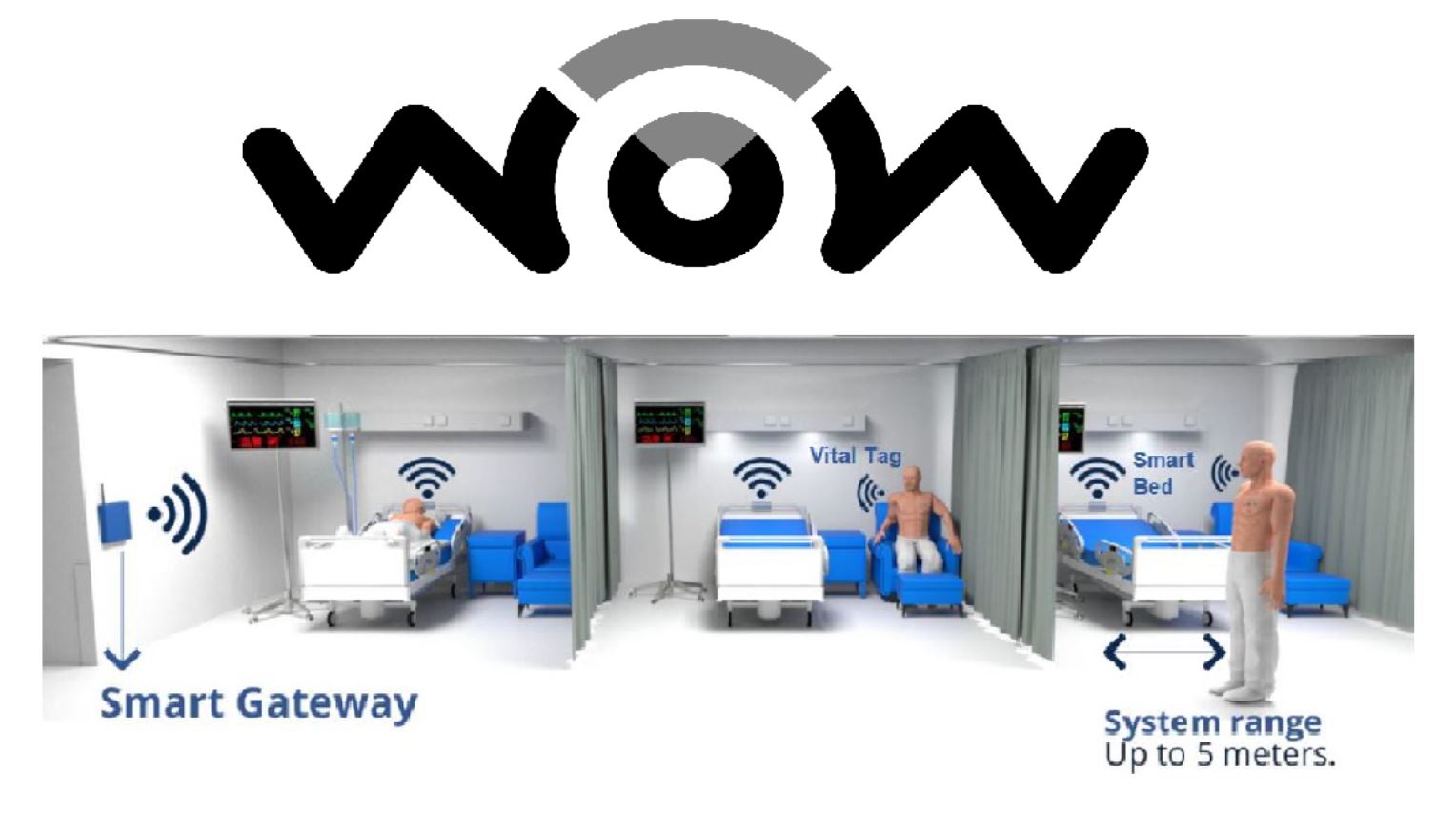
WoW proposes a novel architecture centered on a series of biomonitoring stickers for patients, including fully untethered, simple and very low-cost printed stickers (0.5-20€ depending on the application). In this architecture, patient´s beds will have a central role. An ad-hoc smart IoT unit will be embedded in the beds, as part of an IoT infrastructure that connects to several biomonitoring stickers at one end and to the Hospital Information System (HIS) on the other end. The bed-sticker connection is not limited to data acquisition and transmission, but also enables energy transfer through near field and far field wireless energy harvesting via printed coils and antennas on the stickers. We have already performed initial feasibility studies on the proposed architecture. In addition, each bed is an IoT node that communicates with Globalcare, a proprietary Hospital Information System developed by the project leader company - Glintt. Globalcare virtually covers all hospital activities and needs of hospital teams, also integrating and communicating with other systems.
The project leader, Glintt is one of the main providers of hospital information systems in the country and is present in about 80% of all hospitals in Portugal, as well as in Spain, Angola and Brazil, through subsidiary companies. As end user, the WoW project integrates the Coimbra Hospital and Universitary Centre (CHUC), the largest hospital of the country with a recognized track record in R&D and innovation. WoW will follow up our excellent collaboration with the Soft Materials Lab (Majidi) at CMU, one of the top 5 well-known labs in the field. ISR will lead ICT activities in 3 fronts: Soft and Printed Microelectronics, Energy Harvesting and AI & IoT . At UC, we count on the polymer group (Coelho & Serra) for polymer synthesis and characterization, a group which has a very close collaboration with Matyjaszewski’s group at CMU. The proposed project involves expertise in stretchable electronics, digital health, distributed systems, IoT, AI, software engineering, energy storage and harvesting, embedded systems, material and polymer science, and health, and is an example of a truly interdisciplinary project with clear economic and social impacts.
Reference
POCI-01-0247-FEDER-045913
Funding entity
Agência Nacional de Inovação (ANI)
Role of ISR
Participation
Other participating institutions
Universidade de Coimbra (UC)
Centro Hospitalar e Universitário de Coimbra (CHUC)